
In 2026, television entertainment has clearly reached a turning point. Across the USA, the UK, and Canada, more viewers are questioning whether Cable TV still makes sense or if IPTV is now the smarter option.
With rising subscription costs, limited flexibility, and growing demand for premium content and live television, IPTV has emerged as a strong alternative to traditional Cable TV. But which one is truly better in 2026? This guide breaks down the differences clearly, region by region, to help you make the right decision.
Understanding the Difference Between IPTV and Cable TV
Cable TV delivers content through physical cable infrastructure installed in your home. It usually comes with long-term contracts, fixed channel packages, and additional fees for premium content.
IPTV (Internet Protocol Television) streams TV channels and on-demand content through the internet. Instead of being tied to a cable box, IPTV works on multiple devices and offers far greater flexibility.
In 2026, the contrast between IPTV and Cable TV is more visible than ever.
IPTV vs Cable TV in the USA 2026
Cable TV in the USA
In the United States, Cable TV remains one of the most expensive entertainment options:
- Monthly bills often exceed $100
- Sports channels require extra packages
- Long-term contracts with cancellation penalties
- Regional blackouts for live sports
While Cable TV still provides stable local channels, its cost and limitations frustrate many American viewers.
IPTV in the USA
IPTV has grown rapidly across the USA because it offers:
- Access to US and international channels
- No regional blackouts for live content
- Affordable monthly pricing
- Compatibility with Smart TVs, Fire Stick, Android TV, and mobile devices
For US viewers, IPTV delivers better value, especially for sports fans and cord-cutters.
IPTV vs Cable TV in the UK (2026)
Cable TV in the UK
Cable TV in the UK is dominated by premium providers that bundle entertainment and sports together:
- Expensive monthly subscriptions
- Long contracts (12–24 months)
- Limited flexibility when traveling
- Sports channels locked behind premium tiers
Although Cable TV is reliable, many UK users feel they pay too much for limited freedom.
IPTV in the UK
In 2026, IPTV is increasingly popular in the UK because it provides:
- Access to UK and international channels
- Sports content without restrictive bundles
- Flexible subscriptions with no contracts
- The ability to watch anywhere with internet access
IPTV aligns perfectly with the modern UK viewer who wants control and flexibility.
IPTV vs Cable TV in Canada (2026)
Cable TV in Canada
Canadian Cable TV subscribers often face:
- High monthly prices
- Limited channel customization
- Extra charges for sports and international content
- Regional restrictions
While Cable TV still dominates traditional households, dissatisfaction continues to grow.
IPTV in Canada
IPTV adoption in Canada is rising due to:
- Affordable pricing compared to Cable TV
- Broad access to local and international channels
- Strong performance on multiple devices
- Ideal solution for multicultural households
For Canadian viewers, IPTV offers variety and value that Cable TV struggles to match.
Pricing Comparison: IPTV vs Cable TV (USA, UK, Canada)
| Feature | Cable TV | IPTV |
|---|---|---|
| Monthly Cost | High ($80–$150) | Low ($10–$30) |
| Contracts | Required | No |
| Equipment Fees | Yes | No |
| Sports Add-ons | Extra Cost | Often Included |
| Flexibility | Limited | High |
Across all three regions, IPTV clearly offers better affordability.
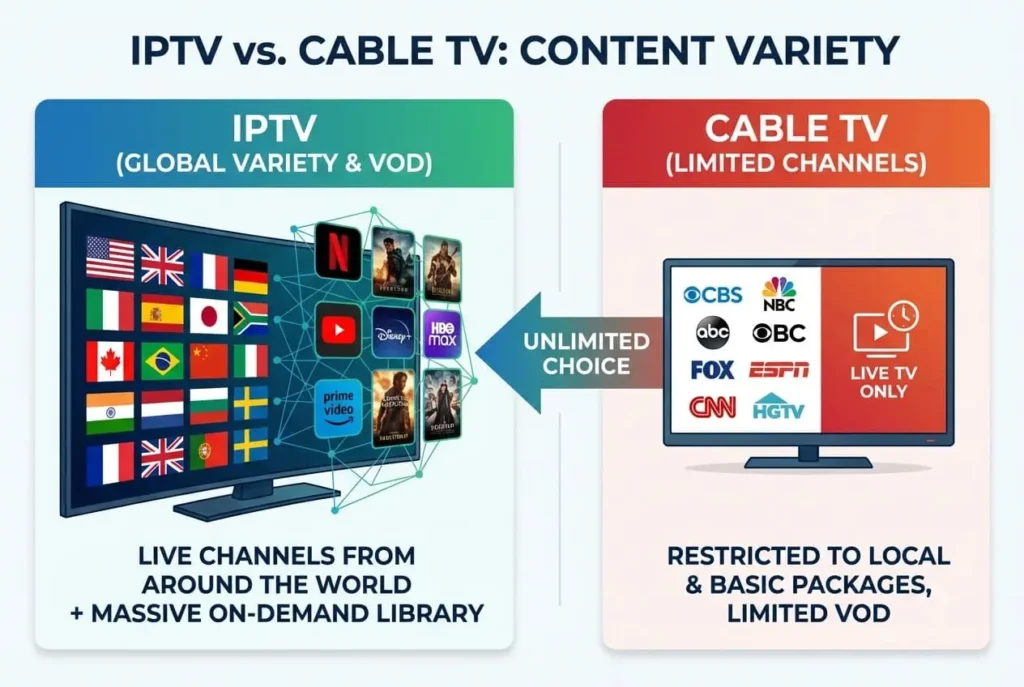
Channel Variety and Content Access
Cable TV
- Fixed channel packages
- Many unused channels
- International content costs extra
IPTV
- Thousands of channels worldwide
- Local + international content
- On-demand, replay, and live TV
- Better customization
IPTV gives users freedom, while Cable TV enforces structure.
Sports and Live Content: IPTV Takes the Lead
For sports fans in the USA, UK, and Canada, IPTV offers a major advantage:
- No geographic restrictions
- Access to global sports coverage
- Live events streamed without blackouts
- Multiple feeds and language options
Cable TV, by contrast, often limits access through regional rules and expensive add-ons.
Streaming Quality and Performance in 2026
Cable TV
- Stable but inflexible
- Limited 4K availability
- Hardware-dependent
IPTV
- HD, 4K, and emerging 8K support
- Adaptive streaming
- Smooth performance with good internet
In 2026, IPTV provides a more modern viewing experience.
Device Compatibility and Mobility
Cable TV is usually tied to one location. IPTV works on:
- Smart TVs
- Smartphones & tablets
- Laptops & desktops
- Streaming devices
This makes IPTV ideal for people who travel or want multi-screen access.
Who Should Still Choose Cable TV?
Cable TV may still suit users who:
- Have unstable internet
- Prefer a traditional setup
- Only watch local channels
However, these users represent a shrinking group in 2026.
IPTV vs Cable TV in 2026: Final Verdict
For viewers in the USA, UK, and Canada, IPTV clearly outperforms Cable TV in most areas:
✔ Lower cost
✔ More content
✔ Greater flexibility
✔ No contracts
✔ Multi-device access
Cable TV still works—but IPTV is built for the future.